


It has been quite a while since I wrote a letter, certainly one focused on my current and recent reading. War has NOT been declared, our President is beguiled by religious omniscience, AI terrifies and thrills in equal measure … meanwhile a huge El Nino will amplify the climate change we barely acknowledge and our debt approaches an epic $40 trillion dollars. It’s a strange world. The glass is also kind half full in the BIG picture of life expectancy, declining carbon footprint and the signs of a long overdue social media and phone backlash. But it remains for me, a daily exercise of ignominy management when we read yet another act of madness or self-aggrandizement or BOTH from a man who still commands almost 40% of the electorate. I think I let too much of this get the better of me and my reading devolved into a fit & start pattern that I have only recently begun to step away from. Especially with the arrival of ChatGPT and the terrifying Alien 2 off-spring, Claude, I have learned what a quicksand the digital experience has evolved (devolved?) into. Serious reading today requires levels of separation and discipline unimaginable to one who grew up with a book as a constant companion.
The following is a list of the books that have reached through my distracted (often for the best of reasons) and at times despairing mind fog and delivered what excellent literature of all forms promise every time we pick a title and begin.
NON-FICTION: (a really “fun” list by the way … in four very different ways)
Advance Britannia by Alan Allport (despite its bulk, it is a very sprightly 487m pages)
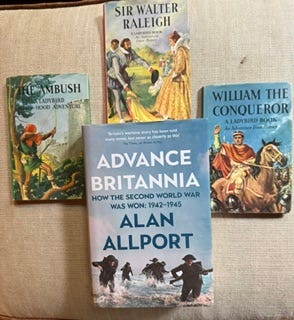
The second half of this widely praised history of Britain’s efforts in World War Two, is an utterly engaging gem. You do not have to be a military history devotee to enjoy (though it helps). The obsession we all have had with WWII is not an American only affair. The same applies to the Brits, particularly after having to digest the horrors of the First World War – the “Great” War. All the Allies who fought the second war want to reimagine it as the great existential crisis that was won – which it was. It was the “good war” in the United States, the “finest hour” for Britain and the Great Patriotic War for the Soviets. What gets lost in the paint job is the fact it remained a WAR that killed over 60 million people and unleashed killing at a level of efficiency and terror previously unimagined – and I am not referring to the worst of it, the Holocaust. I found reading Allport’s elegant, gripping and honest narrative such a relief because it was NOT about America. One can view America in a side mirror while Allport walks you through a narrative of the war Britain fought that might be as terribly unfamiliar to you as it was to me. There are the usual revisions of Churchill and his often-disastrous instincts; however, respect is given where it is due. The British nighttime bombing of Germany is covered with frightening clarity and may be the bit that stays with me longest. I had no idea that the most efficient use of U-Boats was against the shipping along the American East Coast, not the ultimately doomed Wolf Packs. Italy was a massive, tragic folly and the war in Burma may have been even more brutal than the Eastern Front. There is much more to take in in this marvelous book that rewrites with precision, perspective and elan.
Strangers by Belle Burde
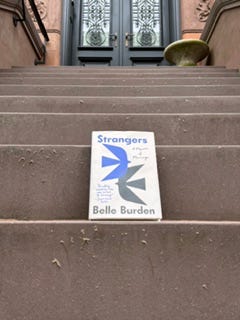
I suspect that in certain circles in our society, you would have to be a cave dweller to have not heard of the buzz around this weekend read. A memoir of a shocking break-up in a society marriage that apparently came utterly out of the blue has gripped mostly women readers everywhere for many predictable reasons. Belle is a blueblood New Yorker, who writes as well as she dresses. My wife heard her speak in an SRO ballroom in a city club and was deeply moved and impressed. Any kind of teaser or summary will spoil the pleasure one gets while reading this short memoir. Belle does not come across as vindictive thus retaining the story’s credibility and veracity. The title is the story and extends to not only the husband as a “stranger” but the possibility that marriage itself is filled with the unknowable. It is a great dinner table conversation – I mean that as a compliment. My biggest hesitation remained, at the end, a suspicion that because marriage can be a riddle wrapped within an enigma, there may be another layer to the tale.
Metropolitans by A.M. Gittlitz
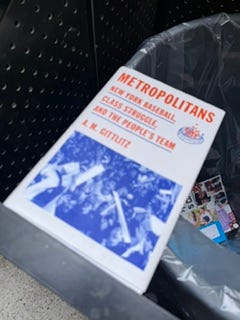
Who but the most die-hard fan wants to read 400 pages about the Mets (hint: originally, the Metropolitans)? Not me … being a serious SF Giants fan I never cottoned to them, resenting Willy Mays’ humiliating end of career in the awful Shea Stadium. When I lived in the city from ’75 to ’84, I was at best a Yankee fan but that was mostly Reggie Jackson and Thurmon Munson fandom. All this aside, I kept reading the enthusiastic, very surprised reviews of Gittlitz’s book and realized while an ode to the Mets, Metropolitans is much more … and it is.
Gittlitz is an unapologetic Marxist whose passion for the Mets is both a love of this storied franchise and an opportunity to deliver an often accurate but always blunt takedown of the capitalistic history of America from the beginnings of baseball to today. You will learn much more than you want to about baseball’s tortured labor relations, but you will get a sharp sliver of the sad story of labor in American history – in my book, the most overlooked of the different cross currents of the American narrative. Still … even that fades under the jocular and vivid tale of baseball’s founding and the great part played by its famous New York teams. Much of this was new to me. The founding of baseball was anarchic and contained within it all that can be splendid and terrible about this country particularly when played out in the great ballpark that is New York City. If any combination of the equally shared subjects of this book – the Mets, baseball, NYC, labor history – are of interest to you, bring with you a permission to skim and give this book a read.
London Falling by Patrick Radden Keefe
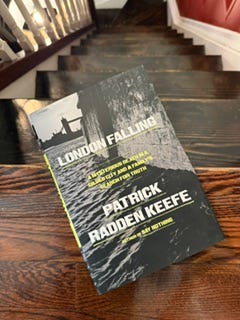
Keefe’s books rattle the world. Empire of Pain laid bare the unvarnished greed behind an opioid pandemic that killed hundreds of thousands of Americans. Say Nothing in its book shape and later as a deeply disturbing series tackled the horror of fanaticism and the addictive nature of violence that has always lain at the heart of The Troubles. London Falling exposes the rotten interior of a great city. Nobody is spared though you will never think the same of the Metropolitan Police let alone the gilded wealth of a city that began to sell its soul with an imperial birth marked by piracy and corporate thievery. The book is riveting and will NOT give you any kind of neatly tied bow at the end. It, thankfully, is half the length of his other works and reads like the terrific series I am sure it will become. The bad guys are the Russian oligarchs, our 21st century version of the Nazis. One realizes that their sudden emergence with their violently gotten billions and mindsets of pure malevolence eventually “cleaned up” by their puppet master (and puppet) Vladimir Putin, was the financial equivalent of the arrival of the plague 600 years ago. The world has not recovered as all levels of authority, from law enforcement to heads of state and the democratic process itself, are compromised by the greatest financial theft in modern history. This review is a long macro rant, but it is the product of Keefe’s brilliant micro research into a financial pathogen that can only be fully revealed under a microscope.
FICTION:
The Searcher by Tana French
The newsletter I wrote recently but did not release, addressed a personal belief that in serious literature, men often write more compelling female characters than women do men. There are good reasons I stepped away from this, but it was not for lack of casual due diligence. While feeling utterly awkward at a historian’s book party my son-in-law brought me to, I was standing in a corner with a senior editor of the NYT Book Review, and I asked her about this belief of mine awaiting a sharp dismissal at best. Instead, she thought there is a lot of truth to it and as she was being pulled away by someone invited to the gathering, she told me to look up Tana French.
I thought French was mostly about serious Gothic stuff but then I found the first book of her Cal Hooper Irish trilogy. The Searcher involves a retired Chicago PD detective who seeks refuge in a cottage on the outskirts of a small town in deeply rural Ireland. You know the drill … hoping to escape the sadnesses and stress of his life in Chicago, he discovers plenty of that in a small town in Ireland. French tells the story through pages of utterly engaging dialogue framed by all the atmosphere of the Ireland you might imagine if you take off the rose-colored glasses. The editor made her point. French has a good angle on the male character and though my belief makes an exception for mysteries (women DO write brilliantly about men in this context), French’s work borders may qualify as an exception given her literary talent. This talent must make her is a shelving issue for bookstores. Also, this reading reminded me of another exception that came up in my “research”, that it is Irish women writers who seem to effortlessly create powerful fully dimensional male characters
My confession is that I listened to 75% of it on Audible. It is read brilliantly by Roger Clark employing an artful collection of brogues. Yet, despite the seductiveness of the reading, I plan to read the second installment in print given what a gifted writer Tana French is.
Nonesuch by Francis Spifford
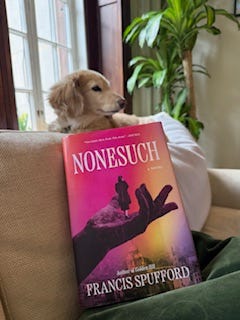
The reviews of this idiosyncratic novel were universally splendid, and, in my mind, the book lived up to them. Spifford is a serious English white male writer. He employs many arts in this ambitious novel, including a Narnia fantasy twist inspired by C.S. Lewis that almost ended my reading. Regardless, I continued, drawn in by the context of the Phony War, the Blitz and a dazzling array of characters. However, what truly drew me in and kept me hooked was an irresistible heroine filled with the power of modern feminism but having to manage the intensely patriarchal world of 1940 London and its financial center, the City. Returning to my earlier point about men writing about women, Spifford’s heroine is a terrific contemporary case in point. I kept returning to the jacket flap to remind me Francis is a male. I do suspect that the fantasy element might have torpedoed his novel with a male protagonist but then he shrugs off this potential snipe by developing a sinister high society blond straight from the darker arts of Harry Potter. A bit unbalanced at times, the book reflects the magnetic energy of a writer owning his personal vision and finding a memorable heroine with which to create it.
The Wizard of the Kremlin by Guilano da Empoli
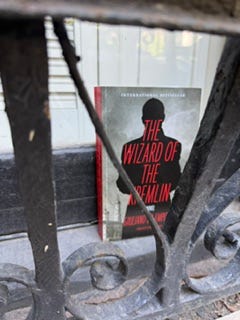
With a Jude Law series coming out as I write this, I doubt anyone would opt for the book it is based on. If done right, the series will very likely eclipse the novel given the dramatic heft of its subject – Vladamir Putin. The main character is Putin’s enabler or amanuensis. The book tracks the rise of both and steps effectively into the steroidal nationalist mindset of Putin and his brand of Russian identity. The West feeds this gang of terrorists and kleptocrats as efficiently as the inept Democratic Party unintentionally feeds MAGA. I was uncomfortably disturbed by the Putinesque read of the West and our mix of arrogance, naivete and (like the Democrats) a gift for dying on the wrong hill. I wonder how much of this will make its way into the series. The book is a study of evil. It in no way excuses today’s Russia but gives the reader an alarming dose of perspective. It is a novel but in no way reads like one. It feels more like a long New Yorker feature piece. I wish it had been.
The Vaster Wilds by Lauren Groff
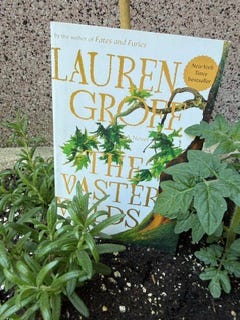
After reading her recent collection of short stories, Brawler, and taking in most of an earlier collection, Florida, I realized I had really missed the boat on her. It was time to read a novel. I had tried Matrix before and worried that I would fail on a second attempt and followed a friend’s advice to look at The Vaster Wilds.
It is a man versus nature novel written by woman about a girl fleeing men, fanaticism, savagery and disease. This is a grim world clearly roughly set during the “killing times” in the English Jamestown settlement of the early 17th century where the horrors of disease and starvation led to 90% mortality rates and a near collapse of this earliest established effort at England’s settlement in America. Though capturing all the texture of the horror, this is not historical fiction though nowadays that category has begun to colonize large sections of fiction. It is a well rendered feminist version of a classic survival narrative. Along side the extraordinarily believable teenage heroine is a natural world that feels every bit like a ‘vast wild’. It ripples with beauty and malice, utterly indifferent to this human’s heroic efforts yet at the same time strangely, even profoundly, accommodating.
This Is Where the Serpent Lives by Daniyal Mueenuddin
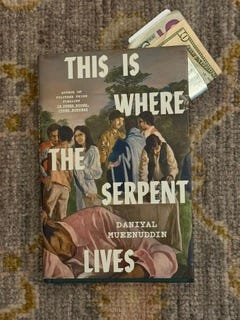
I am drawn to the fiction of South Asia in much the same way as I am to Irish literature. At its best, both genres create a vivid sense of place within which characters come to life in an organic and truthful process that is often lacking in contemporary works in the United States where so much seems forced. This gift of verisimilitude is complimented by the gift of dialogue. Both genres have a very good ear.
Among the many critics who praised this novel, Dwight Garner of the NYT described it as Tolstoyan in its ambition and its ability to contain worlds. I read it despite this review but by the end I must agree with Garner. Pakistan is the official landscape, the seventy years since the Partition is its timeline and everything from caste to family to money and corruption are its subjects. Like so many novels today, there are numerous shifting points of view that, in the end, created a wonderful narrative that gains speed with each page but does leave a few strands left behind. Tolstoy’s gifts are way beyond the scope of this modest review; however, one I appreciate is the ability to weave a densely realized world that with each new stitch increasingly echoes the life we know or suspect we know even if it is on the other side of the world in an utterly different time and place. Tolstoy’s faithful treatment of his Russia allows for a timelessness in his works. I encounter this art in the best works from Ireland and South Asia. I highly recommend this uneven but deeply, in the end, moving novel that flirts with the profound.