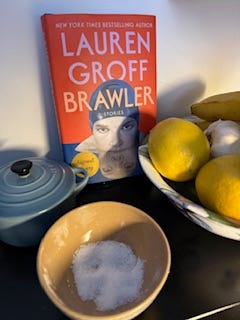
I just finished Brawler, a collection of nine short stories by Lauren Groff. Groff is not my favorite novelist. I have started two of her novels and failed to finish either. She was uniquely unimpressive at a recent Sun Valley Writer’s Conference. It took a big time set of reviews to get me to buy the collection in preparation for a flight. Each review cited her start as a gifted short story writer. The critics are spot-on. The stories are tough, eloquent, often elegiac. They reminded me of the glory of a too often overlooked art form.
My first short story love affair was with John Cheever’s famous Red Book … the stunning collection of his already widely praised short stories. It seemed to be THE cultural accessory during the fall of 1978. All generations were reading it – all 693 pages, 61 stories. Maybe it remains exaggerated in my mind because I was in New York and New England, homes to Cheever himself and the fertile soil for his stories. Maybe it was being young and filled with an abundance of youthful promise. Maybe it was because code and the tech world had yet to destroy the joys of being a Lit major. Later, Tim O’Brien would light things up with his Vietnam collection, The Things They Carried and after that it would be the dark worlds of Raymond Carver. No collection in my lifetime, however, has ever felt more memorable than Cheever’s.
Short stories were “a thing” during the first parts of the 20th century. It seemed every library in my parent’s friends’ world had the Somerset Maugham multivolume collection. There were John O’Hara’s and Irwin Shaw’s now forgotten works everywhere and, of course, the titans ranging from Hemingway & Fitzgerald to the music of J.D. Salinger. People read short stories … a lot of them. While certainly the medium didn’t disappear, by the late Eighties it was no longer so sexy that an issue of Playboy was incomplete without one. After WWII, The New Yorker was the gatekeeper of short story fame. Despite its current famished condition, it remains so today; however, the short story is no longer a prerequisite to literary fame nor a source for publishing success. Book Clubs avoid the medium like the plague, and it seems that the short story apprenticeship has been replaced by the more sensational “debut” novel.
Teaching literature kept me close to the short story. People overlook Hawthorne’s collection in favor of The Scarlet Letter – a mistake. Melville’s brilliant, dense and disturbing short stories cannot compare to Moby Dick, but what can? The Nick Adams stories by Hemingway are as close as literature gets to sacred text. Finally, the strangeness of Flannery O’Connor’s genius remains one of literature’s wonders. Each year I taught a combination of these at different times of the year. There were others that came and went including Tim O’Brien’s collection, Goodbye Columbus by Philip Roth, My Father’s Tears by John Updike and Close Range by Annie Proulx. I strongly urge readers to return and sample these writers’ short works. Who knows where it may take you.
My stab at Groff’s collection might not have happened without another pre-flight airport acquisition, The Manuel for Cleaning Women by Lucia Berlin. I wrote about this collection a few years ago. I hope I made it clear how grateful I was that Berlin reminded me of the unique pleasure that comes with a great short story. Television series are often sloppy, too long, almost always losing their grip as the seasons wear on. This is because they do not have to live within the tough, artistically rigorous confines of a standard 120-minute film. Concision illuminates. Thus, the short story’s gift …
A collection of short stories offers a collection of what makes reading so great. If it is Cheevers 61 stories in his Red Book, it is 61 different endings. It is 61 carefully crafted opening sentences. It is 61 opportunities to surprise, stun the reader. It is 61 different versions of a character arc. It is looking at life as a montage – something I am a real fan of because that is how life often “feels”.
Groff’s collection begins with a bang. It always helps if the best story is at the front. It is short and with an ending that lingers. Often a collection has a longer story, a quasi-novella, and Groff’s is a stunner. The stuff of a good Ang Lee film … if he still made films. One of the reasons people shy away from short story collections is that there will always been a dud or few. Groff’s last effort falls flat but that comes with tackling any collection. The inconsistency of a set of stories is the Achilles Heel of published collections. One must rally from one’s disappoint, give the writer a break, and venture forth. Berlin’s extraordinary collection had several of these and I was always grateful I continued. Ironically, it may require a greater concentrated commitment to read a collection of short stories than an uneven novel because of these “disappointments”. So many mediocre tv series stream successfully because you can “binge”, immediately erasing the weaker episode with something that might rescue your attention. The SHORT story may be a subtle casualty of our increasingly SHORT attention spans.
A good tutorial on how to unpack a short story is George Sanders’ A Swim in a Pond in the Rain. George is likely our finest contemporary short story writer. His writing class at Syracuse is legendary and this book is a quick and easy way to take this class. George, like Groff, is a MUCH better writer of short stories than novels. The latter too often get mired in conceits best left to the shorter form. Regardless, this book centers around Russian short stories and is a treat.
So … exercise your ability to pivot your concentration and tackle Groff’s terrific Brawler
.